The Incal is a science fiction comic book meta-series written in French by Alejandro Jodorowsky and illustrated by Moebius and others. The Incal takes place in, and introduced Jodorowsky's "Jodoverse", a fictional universe in which his science fiction comics take place.
The Incal (These 12 volumes were adapted for american readers, that means that colours are not original (bubble gum colours) any more but it still is good peace)
La Montaña Sagrada (The Holy Mountain, reissued as The Sacred Mountain) is a 1973 cult film directed by Alejandro Jodorowsky who also participated as actor, composer, set designer, and costume designer. The film was produced by The Beatles manager Allen Klein of ABKCO after Jodorowsky scored an underground phenomenon with El Topo and the acclaim of both John Lennon and George Harrison (Lennon and Yoko Ono put up production money). It was shown at various international film festivals in 1973, including Cannes,[1] and limited screenings in New York and San Francisco.
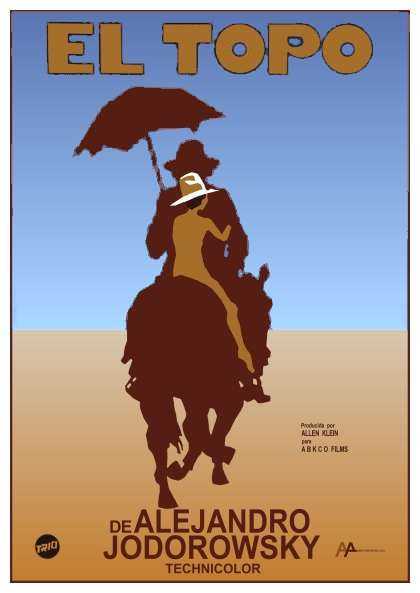
El Topo (The Mole) is a 1970 Spanish language allegorical, cult western movie and underground film, directed by and starring Alejandro Jodorowsky. Characterized by its bizarre characters and occurrences, use of maimed and dwarf performers, and heavy doses of Christian symbolism and Eastern philosophy, the film is about the eponymous character - a violent, black-clad gunfighter - and his quest for enlightenment.
Two men and a woman happen to meet in a bar. We learn from their conversations both the intriguing and banal details of their lives. But is anyone really telling the truth? From the meat market, to the president's drinking habit or the soviet cloning project, this allegory opposes different aspects of contemporary Russian society.
Don`t download if you don't like movies like Stalker, Eraserhead or Tetsuo.
Generation P is the first feature-length screen adaptation of the eponymous novel by the Russian author Victor Pelevin. Work on the film begun at the end of 2006, and it was released in Russian cinemas on April 14, 2011. Like the novel, the film has a complex structure and many intertwined storylines. During work on the film, the plot was subjected to a major reworking: in contrast to the novel, the story of which ends at the end of the 1990s, the film is brought into the present day and even extended slightly into the future. The film is also in many respects built on hallucinations, including a speech by Che Guevara concerning how and why television is destroying humankind.
The film follows Vavilen Tatarsky as he struggles to work and adapt to life in Moscow in the newly independent Russia. Vavilen is a very skilled writer of advertisements, and so he begins working in an advertising agency which promotes Western brands, adapting their advertising campaigns to the "Russian mentality."
Despite having already read the book and knowing fully well what was coming, I was still shocked. Confessions is a disturbing film, a morbid film and what happens is mind-blowing. It is disheartening, scary even, to see middle school students who are close to demented, with no heartfelt mercy or sympathy, who can kill freely for baffling reasons. At the same time, the adult characters are just as heartless. The teacher, Yuko Moriguchi (played by Takako Matsu) is intimidating – her only purpose in life after the death of her daughter is revenge; far from the typical adult mentor and role model that we are so used to seeing.
But the reason why I gave a higher rating to the film than the novel was because the director, Testuya Nakashima, did a marvelous job at taking a mediocre book with stagnant flow and transforming it into an intelligently crafted suspenseful film that maintains realism and proper flow. The 'blue' look (most obvious in the classroom scenes) and the ominous, monotonous soundtrack just adds to the film's darkness. Though the initial confession by Ms. Moriguchi is rather long winded, the rest of the film will consistently confuse, startle and even upset audiences. You will see children involved in relentless bullying and even cold-blooded murder – the middle school students' performances are astonishingly convincing. By the end of the film, you may feel cheated at such a disgusting and horrifying ending. You will be astounded and maybe even depressed at mankind's depravity – if that was the intention of both the author and director, they succeeded in playing a cruel joke on us all.