Sunday, 18 September 2011

W.R.: Mysteries of the Organism

W.R.: Mysteries of the Organism (Serbo-Croatian: W.R. - Misterije organizma, W.R. - Мистерије организма) is a 1971 film by Yugoslav director Dušan Makavejev that explores the relationship between communist politics and sexuality, as well as exploring the life and work of Wilhelm Reich.


Read this after watching the film, otherwise it's be a spoiler! (Text bellow is taken from wikipedia and it explains some of the ideas in the film)

 The film intercuts documentary footage with, predominantly, a narrative about a Yugoslav woman who seduces a Soviet ice skater. Despite different settings, characters and time periods, the different elements produce a single story of human sexuality and revolution through a montage effect. The main elements juxtaposed throughout the film are: Milena is a metaphor for the Yugoslavian working class's struggle for liberation against the totalising influence of the communist state. Milena is killed when her sexual encounter with Vladimir Illych (a reference to Lenin and the representative of communism) goes awry. He, unable to fully experience his orgasmic urge, beheads her with his skate which is the film's metaphor for revolutionary theory. Makavejev dooms self-determination of the Yugslav people, and the struggle of people worldwide for true freedom, to the fate of being totalised by state communism, and the quest for sexual freedom. The song that Vladimir sings in Russian after Milena's murder at the end of the movie is called "François Villon's Prayer" by Bulat Okudzhava.

W.R.: Mysteries of the Organism on wikipedia
W.R.: Mysteries of Organism on the Piratebay

Thursday, 15 September 2011

Alejandro Jodorowsky The Incal

The Incal is a science fiction comic book meta-series written in French by Alejandro Jodorowsky and illustrated by Moebius and others. The Incal takes place in, and introduced Jodorowsky's "Jodoverse", a fictional universe in which his science fiction comics take place.


The Incal (These 12 volumes were adapted for american readers, that means that colours are not original (bubble gum colours) any more but it still is good peace)

Alejandro Jodorowsky The Holy Mountain


La Montaña Sagrada (The Holy Mountain, reissued as The Sacred Mountain) is a 1973 cult film directed by Alejandro Jodorowsky who also participated as actor, composer, set designer, and costume designer. The film was produced by The Beatles manager Allen Klein of ABKCO after Jodorowsky scored an underground phenomenon with El Topo and the acclaim of both John Lennon and George Harrison (Lennon and Yoko Ono put up production money). It was shown at various international film festivals in 1973, including Cannes,[1] and limited screenings in New York and San Francisco.


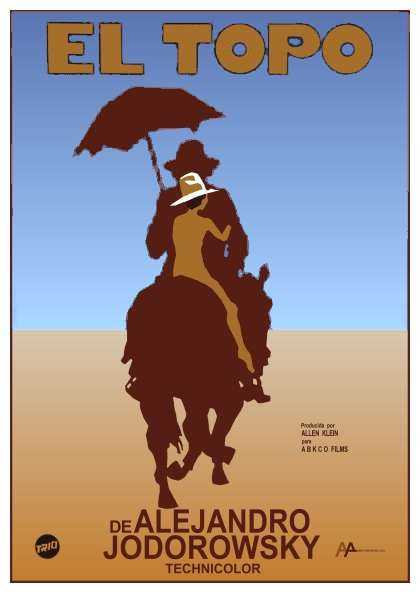
Alejandro Jodorowsky El Topo

El Topo (The Mole) is a 1970 Spanish language allegorical, cult western movie and underground film, directed by and starring Alejandro Jodorowsky. Characterized by its bizarre characters and occurrences, use of maimed and dwarf performers, and heavy doses of Christian symbolism and Eastern philosophy, the film is about the eponymous character - a violent, black-clad gunfighter - and his quest for enlightenment.


Wednesday, 7 September 2011

4


Two men and a woman happen to meet in a bar. We learn from their conversations both the intriguing and banal details of their lives. But is anyone really telling the truth? From the meat market, to the president's drinking habit or the soviet cloning project, this allegory opposes different aspects of contemporary Russian society.

Don`t download if you don't like movies like Stalker, Eraserhead or Tetsuo.


http://extratorrent.com/torrent/805996/4+Chetyre+2005+vid+AC3+Risor+Skullptura.html

Friday, 12 August 2011

Generation P (film)


Generation P is the first feature-length screen adaptation of the eponymous novel by the Russian author Victor Pelevin. Work on the film begun at the end of 2006, and it was released in Russian cinemas on April 14, 2011. 
Like the novel, the film has a complex structure and many intertwined storylines. During work on the film, the plot was subjected to a major reworking: in contrast to the novel, the story of which ends at the end of the 1990s, the film is brought into the present day and even extended slightly into the future. The film is also in many respects built on hallucinations, including a speech by Che Guevara concerning how and why television is destroying humankind.
The film follows Vavilen Tatarsky as he struggles to work and adapt to life in Moscow in the newly independent Russia. Vavilen is a very skilled writer of advertisements, and so he begins working in an advertising agency which promotes Western brands, adapting their advertising campaigns to the "Russian mentality."